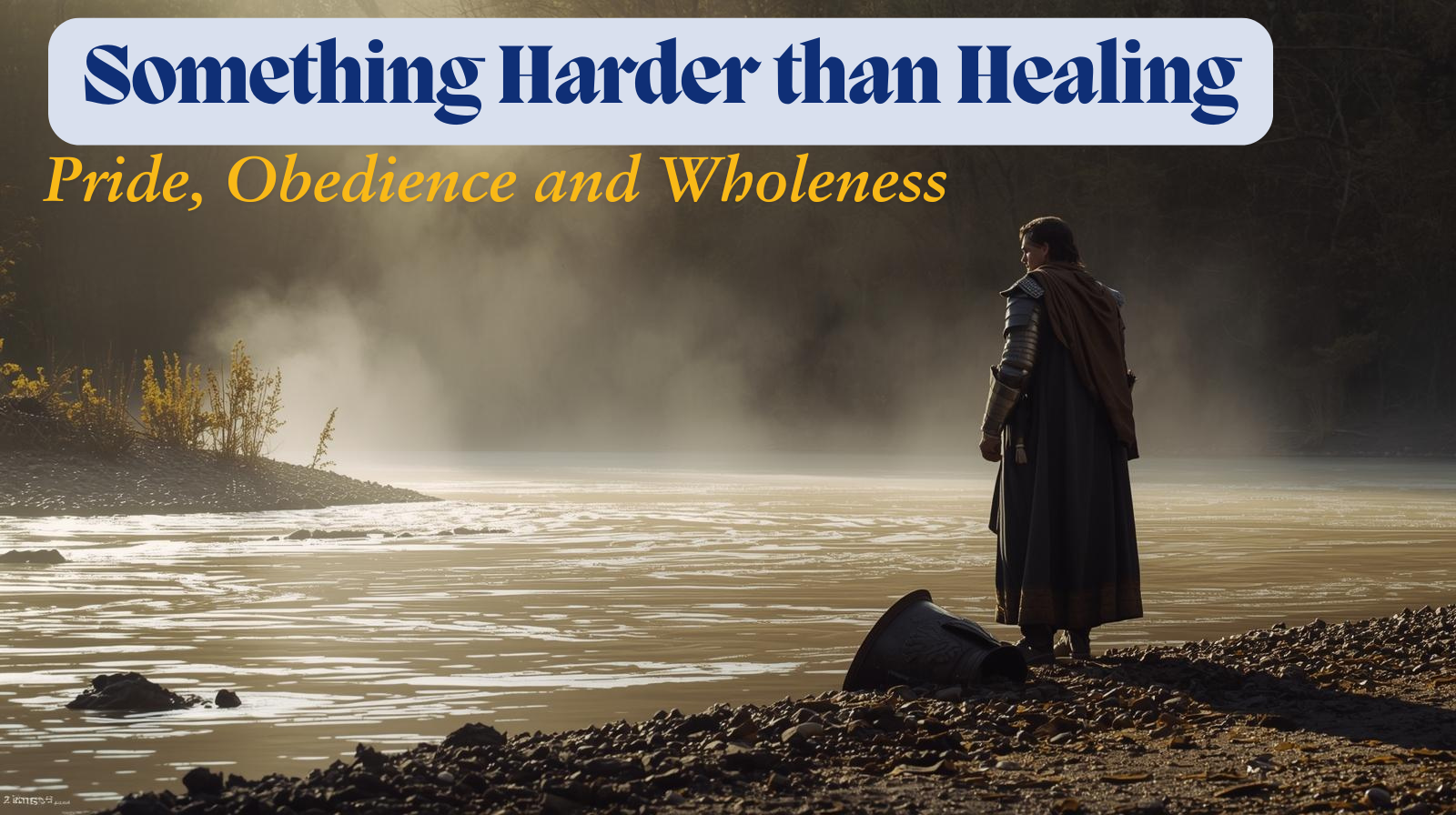
🌟 SOMETHING HARDER THAN HEALING
💭 "When the cure dismantles your identity"
📖 INTRODUCTION
There's something harder than being sick. There's something harder than obeying God. There's something harder than discipline or humility. It's accepting a cure that dismantles your identity.
Let me tell you about Naaman. His story in 2 Kings 5 isn't really about leprosy at all. It's about what happens when pride meets simplicity and recoils.
You see, Naaman wasn't some helpless nobody. This man was powerful—decorated with titles like Commander and Mighty Man of Valor. He was pleasant, wealthy, and considered a national asset. Connected. Respected. The kind of person everyone knew.
And he was diseased. 🩹
Here's where it gets interesting: God doesn't heal him with drama. No lightning bolts. No theatrical display. Just a simple instruction: "Go and wash in the Jordan seven times."
That's when the real battle begins.
🎯 PRINCIPLE ONE: COST
When Healing Costs You Your Image
💡 KEY INSIGHT: Sometimes we resist healing not because it's impossible, but because it's too simple.
Think about what Naaman expected. He probably imagined ceremony—the prophet coming out to meet him personally, prayers with raised hands, some elaborate ritual befitting his status. Recognition. Complexity. Public honor.
Instead? "Go wash in the Jordan seven times."
❌ No prayers ❌ No laying on of hands
❌ No spectacle ✅ Just obedience
Naaman was offended. But here's the thing—he wasn't offended by the difficulty. He was offended by the disproportion. The solution didn't match his self-image.
I've seen this pattern in my own life and in counseling others. A professional refuses to start at entry-level in their dream field because they've "already achieved too much" elsewhere.
🔬 THE IDENTITY THREAT
Research shows that when healing threatens who we believe ourselves to be—a commander, a dignitary, a person above common tasks—resistance increases, even when the outcome would benefit us. Naaman's healing required him to act like any other sick person needing cleansing. That was the real cost.
Plain truth: If healing costs your identity, you'll often choose sickness. I've watched people cling to destructive patterns because those patterns have become part of who they are.
"I'm just a pessimist," they say. "I've always been disorganized." "My family has always struggled with anger."
Little corrections matter. Sometimes the hardest part of change isn't the work—it's letting go of the story you've been telling yourself about who you are.
🤔 PAUSE AND REFLECT
Question for You: What part of your identity is keeping you from the healing or growth you need? Is there a label you've given yourself ("I'm not a morning person," "I'm terrible with money," "I'm just not a book person") that's actually preventing you from changing?
📝 Write it down. Sometimes naming the cost is the first step to paying it.
✅ THREE PRACTICAL ACTIONS ON COST:
1. 🎭 Identify one identity you're clinging to that no longer serves you. This week, do one thing that contradicts that identity. If you say "I'm not a reader," read for 15 minutes daily. If you say "I'm disorganized," organize one drawer completely.
2. 🤝 Find an accountability partner who will call out when you're choosing your image over your growth. Give them permission to lovingly challenge statements like "That's just who I am" with "Is that who you want to be?"
3. 📖 Start a "small obedience" journal. Each day, write down one simple instruction you followed that felt beneath you or uncomfortable—whether from Scripture, a mentor, or even your own better judgment. Watch the pattern over a month.
🎪 PRINCIPLE TWO: CONTROL
Why Leaders Struggle with Simple Obedience
Naaman was accustomed to giving orders, not receiving them. He commanded armies. He made decisions that affected nations. And now some prophet won't even come out to see him?
💬 "I thought he would surely come out to me..."
Those three words—"I thought"—reveal everything. Expectation became obstruction.
📚 A STORY FROM OUR BOOK
My story from our book The Magnitude of the Minute. Despite growing up in poverty—eating pumpkins every way imaginable, having teachers replace his worn uniforms—I understood something crucial about little duties. I didn't wait for the "big" opportunity. I excelled at small assignments, studied faithfully even when no one was watching, and I eventually rose to serve the government as an engineer.
The difference? I mastered compliance before he gained control.
Naaman's servants understood what he couldn't:
"If the prophet had told you to do something great, would you not have done it?"
Greatness would have preserved his sense of control. Simplicity required surrender.
And that's the point many of us miss—we're willing to do the spectacular, but we resist the simple because simplicity doesn't let us stay in charge.
🔄 THE PATTERN WE SEE
Think about it:
- A student will pull an all-nighter cramming for exams (dramatic effort!) but won't dedicate thirty minutes daily to consistent study.
- An employee will volunteer for the high-visibility project but resents the small, daily tasks that actually build competence.
Why? Because consistent, simple obedience means we're not in control of the narrative. We can't point to one grand moment and say, "See what I did?" We have to trust the process.
🤔 PAUSE AND REFLECT
Question for You: What "little duty" have you been avoiding because it feels too small or beneath your current level? What consistent, simple action could you commit to this week that requires surrender rather than control?
Maybe it's:
- Apologizing first in a conflict 🕊️
- Following your budget instead of making exceptions 💰
- Studying for 30 minutes daily instead of cramming 📚
✅ THREE PRACTICAL ACTIONS ON CONTROL:
1. ⏰ Choose one area where you need to surrender control and commit to daily compliance for 21 days. Set a specific time and method—"I will read Scripture for 10 minutes at 6:30 AM" or "I will exercise for 20 minutes at 5 PM." Let consistency build the muscle of obedience.
2. 🧹 Practice the "servant test" this week. When given a task you consider menial, do it with the same excellence you'd apply to your "important" work. Clean that classroom, wash those dishes, complete that paperwork as if it's preparing you for something greater—because it is.
3. 👂 Ask someone you trust: "What simple thing do you see me resisting?" Often others can spot where our need for control is blocking our growth. Listen without defending. Then act on their observation for one week.
🌊 PRINCIPLE THREE: COMPLIANCE
Why Obedience Often Comes Before Understanding
Here's what changes everything: Naaman is healed only after he submits. Not after he understands the theology. Not after he agrees with the method. After he obeys.
💧 The Jordan wasn't magical. Seven wasn't mystical. The power wasn't in the water—it was in the yielding.
This aligns with something behavioral science has shown us: action often precedes belief change, not the other way around. We think we need to understand before we act, but often we need to act before we understand.
👥 REAL-LIFE EXAMPLES
I've watched this play out countless times:
🤝 A couple on the brink of divorce starts practicing small acts of kindness—not because they feel it, but because their counselor instructed them to. Slowly, feelings follow actions.
📊 A student who "hates math" commits to working problems daily, and somewhere along the way, understanding dawns.
📖 JOSEPH'S STORY
Joseph, whose story we tell in our book, understood this principle of little beginnings.
- Sold into slavery → He didn't wait to understand why before he started excelling at his duties
- Thrown into prison unjustly → He didn't wait for justice before he began serving excellently
Each act of obedience—each small compliance with his circumstances—prepared him for promotion.
Healing arrives when resistance ends. 🌟
👑 REMEMBER: "Where there is no vision, the people perish." — King Solomon
But here's what we often miss—the vision must be followed by small, daily acts of compliance. Joseph dreamed of leadership, but he became a leader by faithfully performing small duties in Potiphar's house, then in prison. Little duties matter.
🤔 PAUSE AND REFLECT
Question for You: What is God asking you to do that you keep waiting to "understand" first? What if you tried it for seven days—just like Naaman's seven dips—before demanding to comprehend why?
💭 Sometimes we pray for clarity when God is simply waiting for obedience.
✅ THREE PRACTICAL ACTIONS ON COMPLIANCE:
1. 7️⃣ The "Seven Dips" Challenge: Pick one instruction you've been resisting (from Scripture, a mentor, or even good advice you know is right). Commit to obeying it seven times before evaluating results. Forgive seven times. Pray seven mornings. Study seven sessions. Then assess what changed—not just externally, but internally.
2. ☑️ Create a compliance checklist for areas where you struggle with consistency. Don't make it complicated—just 3-5 simple daily actions:
- Morning prayer? ✓
- Homework before entertainment? ✓
- Kind word to family? ✓
Let the pattern of compliance become its own reward.
3. 🎯 Find your "Jordan River." Identify the simple, unglamorous action that could lead to your breakthrough. Is it that conversation you're avoiding? That application you haven't submitted? That class you won't register for? Do the simple thing you're overcomplicating. This week, take the first dip.
✨ THE REAL MIRACLE
Naaman's skin was restored. Clean. Healed. But something deeper happened:
🙏 "Now I know that there is no God in all the earth except in Israel."
Healing led to reorientation. His power remained, but his posture transformed.
This is what distinguishes Naaman from the man at Bethesda in John 5, who was healed but learned nothing from his healing. That man, when questioned, blamed others and showed no growth.
Naaman? He was fundamentally changed. 🦋
🎁 THE DIFFERENCE
The real miracle wasn't clean skin. It was a humbled will.
God didn't merely heal him—God relocated his allegiance. And that's the difference between recovery and wholeness.
🌱 THE MAGNITUDE OF THE MINUTE
Think about it:
- 7 dips in the Jordan
- 7 simple acts of obedience
- Small actions creating extraordinary achievement
As we say in our work with families and students:
🌾 "Small seeds planted are better than great deeds planned."
You see, everyone has little beginnings:
- 🌳 Even the mightiest tree started as a tiny seed
- 👑 Every success story is built on small things faithfully done
- 🏠 Joseph excelling at little duties in his father's house
- 📖 Andrew studying diligently despite poverty
- 💧 Naaman finally dipping seven times in a muddy river
💎 THE BOTTOM LINE
Little beginnings matter. Little duties matter. Little acts of compliance matter.
🔍 FINAL QUESTIONS FOR YOU:
- What "little" thing is God asking you to do that feels beneath you?
- What simple instruction have you complicated because it doesn't match your image of how healing should happen?
- Perhaps the question isn't whether you'll be healed, but whether you're willing to let healing dismantle the identity you've been clinging to.
👥 ABOUT THE AUTHORS
Dr. Diane Owino and Andrew Owino are authors and teachers who explore the intersection of biblical wisdom, psychology, and human transformation. Their work examines how ancient spiritual truths illuminate contemporary challenges in identity, healing, and personal growth.
📖 Their Books Include:
- Riches and Relationships - Navigating wealth, money, and meaningful connections
- The Magnitude of the Minute - How small actions create extraordinary achievements
- Bites of Betrayal - Better emotional processing for a healthy life
- Families in Quarantine - Navigating family challenges in a pandemic-stricken world
- The Grand Transition - Discovering the mysteries of an effective marriage
- Back to Eden - A journey through the courtship wilderness
🌟 Featured Program:
The Healthy Restoration Program - A Proven 3-Step Lifestyle Shift to Achieve Lasting Weight Loss and Health Freedom Without Medication or Relapse
📚 REFERENCES
→ Steele, C. M. (1988). The psychology of self-affirmation. Advances in Experimental Social Psychology.
→ Oyserman, D. (2009). Identity-based motivation. Psychological Review.
→ Keltner, D., Gruenfeld, D. H., & Anderson, C. (2003). Power, approach, and inhibition. Psychological Review.
→ Fast, N. J., et al. (2012). Power and overconfidence. Psychological Science.
→ Bem, D. J. (1972). Self-perception theory. Advances in Experimental Social Psychology.
→ Prochaska, J. O., & DiClemente, C. C. (1983). Stages of change model. Journal of Consulting and Clinical Psychology.
© 2026 Dr. Diane and Andrew Owino | A Reflection on 2 Kings 5:1-14
Comments (2)
Insightful gems.
God is ready to heal and change our lives completely if only we embrace obedience as key in breaking many barriers that limit our full potential.
Add a comment